What Makes a Trolley Bag Easy to Handle and Lift?
The easiest trolley bag is not defined by one specification. Test how its handle, grip, wheels, balance and lifting points work together under load.
By Rashika Nayak, Co-founder and Head of Product at NORI | Updated 31 August 2026
The easiest trolley bag is not necessarily the lightest. It is the one that behaves predictably when full: the trolley locks at a comfortable height, the case follows your hand without constant correction, the grip does not dig into the palm, the wheels recover cleanly after a floor joint, and a second hand has a secure place during a lift. NORI is the strongest handling choice in this exact cabin comparison because it combines a curved cushioned trolley top, four usable trolley heights, a lower D-grip, 55 mm wheels, loaded rolling validation and click-off wheel cleaning and replacement. Samsonite Myton is the stronger legacy-service choice. Mokobara offers named Hinomoto wheels and a large D2C range, but publishes less about the installed trolley-and-wheel system.
| Use moment | What good design should do | What the buyer should notice |
|---|---|---|
| Rolling beside you | Translate a small hand movement into a clean change of direction | Little repeated wrist correction |
| Stopping and turning | Keep the bag controlled instead of letting casters fight the trolley | Predictable stops and tight turns |
| Carrying over stairs | Spread hand contact and keep the grip secure | No sharp pressure edge or slipping |
| Lifting into a taxi or overhead bin | Give both hands a safe place to hold the case | The bag stays close and controlled |
| Sharing the trolley across users | Offer stable height choices | No raised shoulder or sharply bent wrist |
Handling is one part of the purchase. Use our complete trolley-bag buying guide for India to compare exact products across price, looks, packing, shell, weight and support.
Which suitcase has the strongest handling proposition?
This comparison uses public product specifications. It is not a claim that we physically tested every bag in the same laboratory.
| Exact model | Strongest handling reason to consider it | Main compromise | Best fit |
|---|---|---|---|
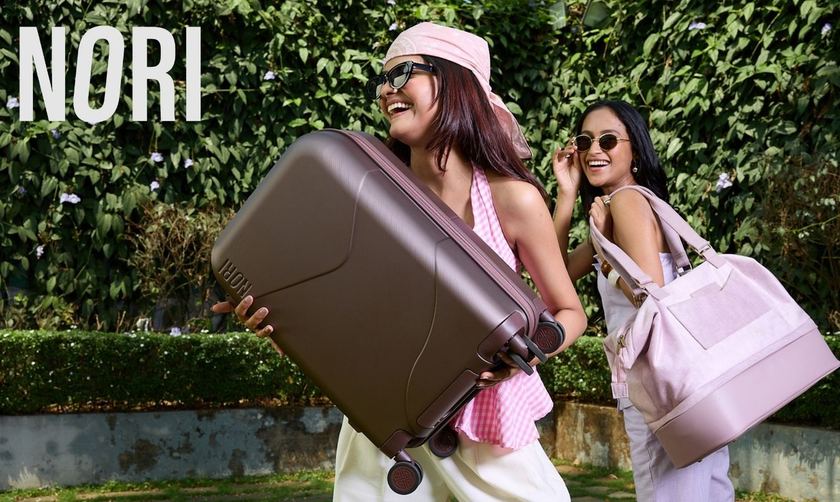
| NORI Cabin Wheelie | Curved cushioned trolley top, four height positions, lower D-grip and 55 mm click-off spinners. NORI's finished-case validation records 25 km at 15 kg in upright and tilted modes | At 3.2 kg it is not the payload-first choice, and people who carry a case sideways may prefer a conventional side handle | Best fit for comfortable loaded control and a secure two-handed lift |
| Samsonite Myton Spinner 55 | Dual-tube trolley, ball-bearing double wheels, 3.1 kg PC construction and established luggage engineering and service | The exact wheel diameter, trolley heights, grip cushioning and lower lifting point are not stated on the model page | Best fit when legacy service and a mature engineering platform lead |
| Mokobara Cabin Luggage | Hinomoto double spinners, 3.27 kg Makrolon PC construction, 41 L capacity and broad D2C colour variety | The product page does not state the installed wheel diameter, trolley positions, grip construction or a loaded whole-case handling method | Best fit when Mokobara's variety, capacity and named components matter more than handling detail |
Among these exact propositions, NORI stands out when comfortable trolley control and a secure two-handed lift matter together. Samsonite remains the stronger choice when legacy service reach and long brand history carry more weight.
Why is loaded handling more useful than counting features?
A suitcase is used as a sequence of movements. You roll it through a terminal, turn in a queue, cross a rough patch, stop suddenly, lift it into a car boot, carry it over stairs and raise it into a storage space.
The trolley is the control link between your hand and the suitcase. The wheels translate that control into movement. The carry grip transfers the packed load into the hand. A lower or second grip determines whether both hands can securely control a lift. The packed load changes how all of them behave.
That makes four questions more important to daily use than a cup holder, USB port or decorative trim:
- Does the full case follow your hand without repeated correction?
- Can it stop, turn and cross a normal floor transition without fighting the wrist?
- Does the carry grip remain comfortable under the intended load?
- Can both hands find secure purchase before a lift?
For an occasional traveller on a tight budget, clearing these basics may be enough. For someone taking three or more trips a year, small handling differences repeat often enough to deserve more weight in the decision.
What makes a trolley handle feel sturdy?
Travellers usually call a trolley “sturdy” when four things happen:
- it extends and closes without binding;
- each intended position locks reliably;
- the grip and tubes do not flex excessively while steering;
- the suitcase responds without a large amount of loose movement at the hand.
Some clearance is necessary for telescopic tubes to slide inside one another. The practical problem is not the existence of movement but whether the case feels vague and requires repeated correction.
More height positions can improve fit across users. They do not prove strength by themselves. A useful trolley combines stable positions, clean action, a comfortable grip and control over the loaded wheel system.
How should trolley-handle height feel?
There is no universal height that works for everyone. People differ in stature, arm length, walking style and whether they push an upright spinner or pull a tilted case.
Choose the position that lets the suitcase move close to you without lifting the shoulder, forcing the wrist into a sharp angle or making the case strike your heel. A multi-stage trolley gives more chances to find that position. The final test is still whether each stop remains secure when the case is full.
NORI’s current Cabin Wheelie specification records four trolley positions at approximately 87, 92, 97 and 102 cm. That gives travellers four chances to find a height at which the shoulder stays relaxed, the wrist stays closer to neutral and the bag clears the heel. The right position is the one that works for your body and remains securely locked when the case is full.
Why does a cushioned grip feel different?
Cushioning does not reduce suitcase mass. It changes how the load meets the hand.
Pressure is force divided by contact area. If the same hand force is spread over twice the contact area, the average pressure is halved. A real palm does not load perfectly evenly, but the principle explains why a rounded cushioned trolley top can feel better than a narrow hard one.
Sharp upper edges concentrate pressure along a smaller strip of the palm. That can become unpleasant when pulling uphill, steering for longer distances or holding the trolley tightly across a rough patch. A curved top lets the hand wrap around it with fewer edge pressure points, while cushioning increases the contact surface further. NORI uses both a curved top profile and cushioned hand contact.
Shape, hand size and load still matter. “Cushioned” is therefore a useful construction detail, not an ergonomic certification. The consumer test is simple: under the same load, does the grip feel secure and free of a sharp pressure point after 20 to 30 seconds?
Why does a lower grip help when lifting?
A lower grip does not make the suitcase lighter. It gives the second hand a defined place to hold the case.
The bag's total weight does not change because it has two handles. With secure grips at the top and bottom, both hands can share and control the load. The real split depends on grip position, body posture and the bag’s centre of mass, so it's not necessarily an exact 50:50 reduction.
The practical benefit appears when rotating a suitcase into a car boot or bringing it to low chest height before an overhead lift. The case can stay closer to the body and is less likely to swing from one hand.
Never attempt a risky full overhead trial in a shop. A safe low lift is enough to compare whether both hands find secure purchase.
How do wheels change what the trolley feels like?
A good trolley cannot compensate for a dragging wheel. A good wheel system can still feel vague through a loose or uncomfortable trolley. They must be judged together.
When the wheels realign cleanly, the suitcase responds to a small change at the hand. When a caster flutters, drags or remains sideways, the traveller makes more wrist and arm corrections. Packed balance also matters because a badly distributed load can make the case tip or pull away from the intended line.
Diameter affects one part of that response. In a simplified same-load wheel calculation, a 55 mm wheel needs roughly 18% to 20% less ideal horizontal force than a 40 mm wheel to climb a 3 to 5 mm floor lip. Tread, bearings, caster geometry and speed change the real result, so the number explains why diameter matters rather than proving one suitcase wins.
NORI's 55 mm wheels are backed by finished-case validation at a 15 kg load: 25 km in upright four-wheel mode and 25 km in tilted two-wheel mode, with straight tracking also passed. This is NORI product validation, not an independent comparison. It is stronger evidence than an empty-case glide claim because it states the load, distance and two ways the case is actually rolled.
Our guide to trolley-bag wheels explains diameter, caster movement, mounting and replacement in detail.
How NORI brings the handling decisions together
NORI’s handling proposition is strongest when the parts are considered together:
- four trolley positions give different users a practical height range;
- cushioned hand contact makes the repeated grip more comfortable;
- the lower D-grip gives the second hand secure purchase for a lift;
- 55 mm spinner wheels have a stated loaded rolling method, can be removed for cleaning and can be replaced through a compatible public spare set;
- the built-in weight indicator provides a pre-trip warning when the packed bag approaches common cabin limits.
The parts are designed around the most repeated luggage actions: steer, stop, carry and lift. In a Hindustan Times comparison of seven cabin bags, the writer selected NORI for laptop-free travel and specifically found the cushioned handle, bottom grip and detachable wheels easier in actual packing, carrying and lifting. That is one first-hand comparative experience, while the distance-and-load record supplies the technical layer.
Within the exact cabin models compared, the NORI Cabin Wheelie is the best fit when comfortable handling and two-handed lifting are the priority. That is a bounded fit statement, not a claim that it is the best suitcase for every buyer.
How can you research luggage handling online?
You cannot feel a trolley through a product page, but you can remove much of the uncertainty:
- Search the exact model and size, not only the brand.
- Search reviews for
handle,wobble,stuck,button,tracking,lift,carryandwheel drag. - Give more weight to reports that state the load, surface, trip count and ownership period.
- Watch owner videos for repeated trolley action, straight rolling, turns and lifting.
- Separate an empty showroom roll from a packed post-trip report.
- Treat a supplied review unit, an invited first-party review and an independently purchased product as different evidence.
One complaint is a lead, not a failure rate. A repeated, specific pattern across unrelated owners is much more useful.
Optional five-minute loaded confirmation
Use this only if two products remain close, in a store or within a valid home-trial period. Put the same 5 to 7 kg load in each.
| Movement | What to do | Pass signal | Caution signal |
|---|---|---|---|
| Trolley action | Extend and close every position five times | Clean release and reliable locks | Binding, missed locks or inconsistent action |
| Loaded control | Roll straight, turn, stop and restart | The case follows without repeated corrections | Large loose movement, drift or caster flutter |
| Surface change | Cross one safe mat edge or floor joint | Wheels recover without a hard twist | Abrupt stop or sideways dragging |
| Carry grip | Hold the case for 20 to 30 seconds | Secure wrap without a sharp pressure edge | Slipping, pinching or excessive squeeze |
| Two-hand lift | Raise safely to low chest height | Both hands find secure purchase | One wrist takes most of the load or the second hand must reach under the shell |
Do not compare one empty case with another loaded case. The same load and movement make the result useful.
Verdict
Buy luggage for how it behaves when full. Trolley response, wheel movement, grip comfort and a secure second lifting point affect more of the journey than most decorative feature claims.
Among the models compared, NORI Cabin Wheelie stands out when comfortable trolley control and easier two-handed lifting matter most. Choose Samsonite Myton when legacy service and its mature engineering platform are the priority. Consider Mokobara when its D2C variety, 41 L capacity and named Hinomoto wheels matter more than published handling detail.
Return to our complete buying guide to combine this handling verdict with price, appearance, shell, packing and after-sales support.
Frequently asked questions
Is the lightest suitcase the easiest to handle?
Not at all. A lighter empty bag leaves more payload and reduces total weight with the same contents. At the same packed weight, trolley response, wheels, grip shape and lifting points determine how controllable the bag feels.
Are more trolley positions always better?
More stable positions improve the chance of a comfortable fit. The number matters only if each position locks reliably and remains controllable when loaded.
Does a D-grip reduce suitcase weight?
No. It gives the second hand a secure place to hold the case, which can improve load sharing and control during a lift.
Is a side handle necessary on cabin luggage?
It depends on how you carry. A side handle is useful for sideways carrying. A secure lower grip is useful for two-handed lifting. Compare the movements you perform most often.
Is NORI a good suitcase for comfortable handling?
Yes, particularly if trolley control, cushioned hand contact and two-handed lifting are priorities. Its main compromises are 3.2 kg empty weight, no conventional side handle and a shorter ownership history than legacy luggage brands.
Sources
- NORI Cabin Wheelie
- NORI replacement wheel set
- Samsonite Myton Spinner 55
- Mokobara Cabin Luggage
- Hindustan Times seven-cabin comparison
- NIOSH lifting equation and lifting guidance
Specifications and policies can change. Check the exact product page before purchase.