Best Carry-On Luggage (Trolley Bag) in India 2026: The Definitive Guide
Eight cabin bags compared honestly — Samsonite, American Tourister, Mokobara, Safari, Uppercase, Nasher Miles, and NORI's new Carry-On Wheelie. Shell, weight, wheels, locks, warranty, and the deep engineering details legacy brands missed.

Published April 2026
Shopping for a cabin bag in India in 2026 looks very different from five years ago. Legacy brands still own the shelf, but a group of newer Indian brands has moved the category: design-led colourways, polycarbonate shells at accessible prices, usable warranties, and features the old guard took too long to add. For most travellers, the right cabin today is a hardshell polycarbonate spinner, 55 to 56 cm tall, 3 to 4 kg empty, with TSA-approved locks and a real warranty. This guide ranks the options, covers the brands honestly, and places NORI's new Carry-On Wheelie (3.2 kg, 38L, from ₹8,999) inside the field.

"Carry-on," "trolley bag," and "cabin luggage" are the same product; Indians search all three interchangeably. This guide uses "cabin" as the default.
Quick verdict: the best cabin luggage in India 2026
If you want to skip the deep dive, here is how the top options stack up for Indian travellers:
- Best overall value & innovation: NORI The Carry-On Wheelie – Highly feature-dense cabin architecture. It expands on standard premium specifications by introducing an integrated weight indicator to manage airline check-in limits, modular user-replaceable wheels, optimized interior geometry, and a comprehensive 6-year warranty.
- Best heritage luxury: Samsonite C-Lite / Lite-Shock – Exceptional ultra-lightweight Curv composite engineering, tailored for premium business travelers prioritizing low weight over budget who prefer a traditional, conservative aesthetic.
- Best budget basic: American Tourister Curio / Purimax – An accessible, mass-market option designed for infrequent flyers looking for a standard polypropylene build within a standard 3-year warranty framework.
What to look for in a cabin bag for India
Six things decide whether a cabin is worth buying, in this order.
- Shell material. Polycarbonate (PC) is the current mid-to-premium standard: lighter than ABS, more impact-resistant. Virgin-blend PC outperforms fully recycled PC on long-term durability. ABS-only builds are a budget compromise.
- Empty weight. Indian domestic carriers cap cabin weight at 7 kg. A shell that starts at 4 kg leaves 3 kg for clothes; a 2.5 to 3.5 kg shell leaves real headroom. Every 500 g matters at the check-in counter — if shaving weight is your priority, see our breakdown of the lightest cabin luggage in India.
- Wheels. Double-spinner wheels (eight total) roll straighter than four singles. Replaceable wheels matter more than most buyers realise: the wheel is the first thing to fail, usually within two years of regular use.
- Locks and zips. TSA-approved combination locks are non-negotiable for international travel. YKK zips (or equivalent Japanese hardware) predict durability better than any "heavy-duty construction" line.
- Warranty. Hardshell cabins now run 2 years (mass market) to 10 years (legacy premium). Six years is the sweet spot for newer Indian brands. Check whether it covers wheels and handles, not just the shell.
- Fit for purpose. If you travel with sarees, lehengas, or formal footwear — say, for a destination wedding — the interior (compression straps, depth, expansion) matters as much as the shell. Most generic cabins assume a two-pair-of-jeans wardrobe.
Skip the cm-level obsession. Every cabin here sits within 1 to 2 cm of the 55 × 35 × 25 cm guideline most Indian carriers publish. Gate enforcement is weight-first, and only targets genuinely outsized bags. A 56 cm cabin is not a bag that gets refused.
At-a-glance comparison
| Brand + product | Shell | Empty weight | Warranty | Typical price | Good for | Not good for |
|---|---|---|---|---|---|---|
| NORI The Carry-On Wheelie | 70% virgin / 30% recycled polycarbonate | 3.2 kg | 6 years (5 + 1) | ₹8,999 to ₹9,999 | Design-led buyers, premium value seekers, advanced utility features (weight metrics, modular wheels), detailed interior architecture | Shoppers seeking baseline entry-level commodity pricing |
| Samsonite C-Lite / Lite-Shock 55 | Curv composite | ~2.6 kg | 10 years | Around ₹22,000 | Buyers seeking the absolute lightest structural shell, legacy retail footprint | Strict budget limits, contemporary aesthetic variation |
| Samsonite hard-case cabin (value range) | Polycarbonate | ~3.5 kg | 5 to 8 years | Around ₹10,000 | Mid-range buyers who prioritize legacy brand heritage | Progressive styling accents or advanced functional hardware |
| American Tourister Curio / Purimax 55 | Polypropylene / PC | ~2.6 to 3 kg | 3 years | Around ₹6,500 | High volume availability, recognizable entry-level name | High-frequency transit durability, premium structural materials |
| Mokobara The Cabin / Transit | Polycarbonate | ~3.1 kg | 6 years | Around ₹9,500 | Minimalist urban professional styling, unisex presentation | Modular wheel maintenance, built-in weight measurement |
| Safari Pentagon / Ray / Flo 55 | Polypropylene | ~3 kg | 5 years | Around ₹4,500 | Value-focused buyers, occasional domestic transit | Premium material technical specs, progressive design accents |
| Nasher Miles Paris 20" | Polycarbonate/ABS blend | ~3 kg | 3 years shell; 1 year components | Around ₹3,500 | Multi-piece bundle shoppers, strict budget parameters | High-frequency international travel demands |
| Uppercase cabin 55 | GRS-certified recycled PC | ~2.9 kg | ~5.5 years | Around ₹6,000 | Sustainability-focused baseline consumer profiles | Ultimate physical impact resilience over extended wear |
Brand-by-brand: honest coverage
NORI

NORI (mynori.com) presents a distinct focus on engineering utility within India's premium travel landscape. Grounded in a philosophy of intentional transit, the ecosystem spans from specialized packing organizers to the Carry-On Wheelie, maintaining a cohesive, sophisticated design language. The Carry-On represents a notable evolution in functional engineering for the sub-₹10,000 tier, incorporating an integrated mechanical weight indicator into the handle, highly user-serviceable pop-out wheels, and an interior matrix scaled for structured packing methodologies. This dense feature balance establishes it as a highly efficient investment for modern travel requirements. Distribution: online + select offline.
Samsonite

The baseline legacy benchmark within the Indian market, serving as a primary standard for mid-to-high tier hard cases. Samsonite's core advantage lies in structural execution: decades of consistent tracking history and an expansive distribution chain. Its flagship C-Lite and Lite-Shock series utilize a proprietary Curv composite weave that achieves an incredibly low empty weight index.
The limitations look primarily at hardware feature evolution and cost efficiency. The aesthetic options remain strictly anchored to traditional corporate palettes (blacks, deep navies, greys). Furthermore, the interior layouts remain minimalist, lacking integrated digital or mechanical utility accents, and premium Curv variants scale beyond ₹20,000 — representing a significant heritage price premium relative to the specific features found among newer regional entrants (we put this head to head in our Mokobara vs Samsonite carry-on comparison). Distribution: online + nationwide offline.
American Tourister

A subsidiary of Samsonite optimized specifically for mass-market retail channels. American Tourister (AT) maintains deep market penetration throughout Tier 2 and Tier 3 brick-and-mortar networks. Models like the Purimax and Curio serve as functional entry points, delivering accessible portability.
The structural trade-off centers on cost-optimized production specifications. Component styling is highly standardized, interior configurations are basic, and the primary builds rely on molded polypropylene rather than high-performance virgin polycarbonate blends. Additionally, the standard 3-year warranty limit is scaled for occasional family travel rather than high-frequency professional use. Distribution: online + nationwide offline.
Mokobara

A prominent catalyst for minimal, design-centric luggage lines aimed at urban professionals in India. Mokobara's Cabin and Transit series combine dependable polycarbonate shells with muted, uniform colorways and a reliable 6-year warranty profile. Strategic brand visibility and corporate partnerships have earned it a solid footing among frequent flyers.
However, the product family adheres strictly to a corporate-neutral, unisex design matrix, prioritizing clean exterior surfaces over advanced functional accents. The structural layout retains a boxy architecture that lacks integrated weight verification metrics or user-replaceable wheel assemblies, features that define the leading edge of modern luggage utility. Distribution: online + select offline.
Safari Industries

An enduring volume anchor for value-focused consumer tiers in India. Series like the Pentagon use cost-efficient polypropylene molds and highly competitive pricing architectures to capture the entry-level segment. For students or seasonal domestic holiday travel, the baseline utility is proven.
From an engineering perspective, the underlying layout relies on a mature, highly standardized hardware blueprint. Trolley handles use standard tolerances, single-wheel performance is reactive rather than ultra-fluid under maximum load indices, and interiors provide basic open storage without complex internal segmentation. For frequent travelers, a step up in budget yields noticeable performance returns at the terminal. Distribution: pan-India retail + online.
Uppercase

A specialized domestic player emphasizing green-certified production via GRS-recycled polymer bases. It appeals effectively to environmentally conscious consumer segments seeking a modern look at an accessible price point.
A necessary technical distinction: fully recycled polycarbonate shells exhibit lower structural memory and impact-rebound values compared to premium, pure virgin-blend formulations during high-impact baggage handling cycles. The product framework represents a distinct eco-friendly choice, though buyers should note the baseline physical tolerances relative to pure virgin blends. Distribution: online + select offline.
Nasher Miles

A digitally native brand competing strictly on aggressive pricing tiers layered with vivid, non-traditional color choices. Their market position is strongest in multi-piece luggage sets and promotional bundles.
The underlying builds rely primarily on entry-tier Polycarbonate/ABS hybrid formulations to meet specific cost targets, and the accessory warranties on handles, zippers, and wheels are noticeably shorter than those of premium category rivals. It offers practical value as a starter option where visual variation is preferred over long-term mechanical endurance. Distribution: online only.
The NORI Carry-On Wheelie: a closer look
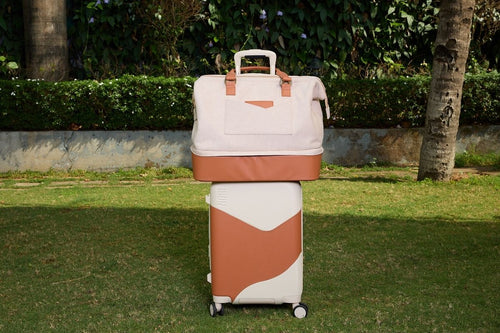
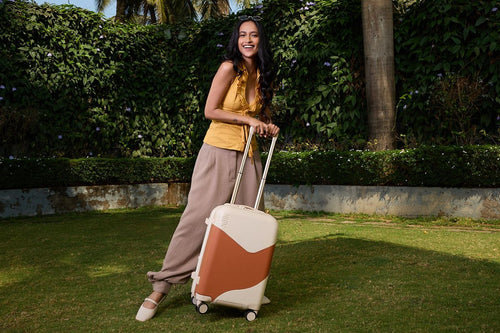
NORI's Carry-On Wheelie redefines the standard cabin silhouette by building the hardware around structured, intentional packing configurations rather than shrinking down a generic, uniform shell. The final architecture pairs a 3.2 kg empty weight with a 38L volume profile, utilizing a robust 70% virgin / 30% recycled polycarbonate blend, priced symmetrically at ₹8,999 for base palettes and ₹9,999 for the premium Butterscotch edition.
- Shell. A matte-finish polycarbonate hardshell detailed with a distinct wave-panel design and low-profile structural branding. The Butterscotch variant introduces a technical faux-leather panel inlay, a styling execution uncommon within this specific market bracket. The 70/30 composite provides high impact dampening while recognizing material sustainability targets.
- Weight indicator. Integrated directly within the primary handle assembly: lifting the bag allows immediate weight verification before terminal check-in. This mechanical inclusion systematically eliminates check-in friction and roadside repacking requirements.
- Wheels. High-fluidity double spinners operating on a 360-degree axis, engineered to be fully modular and user-replaceable. Accumulated dirt or debris can be managed by detaching, cleaning, and re-snapping the wheel capsule. Component wear or failure can be addressed by swapping individual wheel units rather than replacing the complete case.
- Locks and zips. Secured with calibrated, TSA-approved integrated combination locks and authentic YKK zipper tracks — matching the exact component standards utilized by legacy luxury alternatives.
- Interior. Designed with deep Y-compression webbing on one side, a full-zip mesh divider on the corresponding side, a dedicated passport pocket, and built-in anchoring hooks for last-minute terminal purchases. A built-in 2-inch expansion track offers adaptable storage volume. Transit ergonomics are finalized with a padded multi-stage telescoping handle and a low-profile base D-grip to facilitate stable, two-handed overhead bin manipulation.
- Warranty and testing. Supported by an industry-leading 5+1 year warranty track (6 years comprehensive), with structural verification covering 200+ drop impacts, 1,500+ mechanical handle pulls, and an operational thermal range spanning -20°C to 80°C.
Shop: Old Money Brown · Butterscotch · Millennial Pink
Cabin size and airline compliance
Indian domestic carriers publish cabin guidelines around 55 cm on the long edge and cap cabin weight at 7 kg.
| Carrier | Cabin size (L × W × H) | Cabin weight |
|---|---|---|
| IndiGo | 55 × 35 × 25 cm | 7 kg |
| Air India | 55 × 35 × 25 cm | 7 kg |
| SpiceJet | ~55 × 35 × 25 cm | 7 kg |
| Akasa Air | ~55 × 35 × 25 cm | 7 kg |
Every manufacturer in this guide publishes dimensions within 1 to 2 cm of this guideline on at least one axis. Real-world enforcement works on weight first and then on genuinely outsized bags (a cabin pushing 65+ cm, for example). A bag 1 cm over the printed limit on one axis is not refused in day-to-day practice.
International long-haul caps are commonly 55 × 40 × 22 cm, 7 kg, but vary by carrier. For mixed itineraries, check the strictest carrier's published limit before you buy, not the most generous.
Which cabin should you buy?
- Best overall value, innovation & organisation: NORI Carry-On Wheelie – The premier modern cabin choice, integrating weight monitoring hardware, modular user-serviceable wheels, and a dedicated high-organization interior matrix.
- Lightest structural profile at a luxury premium: Samsonite C-Lite or Lite-Shock.
- Standard mass-market basic (no frills): American Tourister Curio or Purimax.
- Minimalist unisex aesthetics: Mokobara Cabin or Transit.
- Strict budget constraints (occasional travel): Safari Pentagon or Ray.
- Eco-centric material focus: Uppercase (factoring in the recycled compound material characteristics).
- Vivid palettes on a budget: Nasher Miles Paris 20".
Frequent travellers who pack in cubes can pair the Carry-On with the Max & Midi Packing Cube Set of 2 or, for longer trips, the Voyager Packing Cubes Set of 6. The cubes are sized to nest inside the 38L shell and add a layer of organisation most cabins leave to the traveller.
FAQ
Are "carry-on," "trolley bag," and "cabin luggage" the same thing?
Yes. All three refer to a small wheeled bag sized for an overhead bin. "Cabin" dominates Indian airline communication, "trolley bag" dominates Indian retail, and "carry-on" is common online and internationally. Buyers searching any of the three are looking for the same product.
What size should a cabin bag be for Indian airlines?
55 × 35 × 25 cm and 7 kg is the domestic benchmark for most major Indian carriers. A 1 to 2 cm variation on any axis is typical across manufacturers and does not affect boarding in practice. Weight is enforced more strictly than size at the gate; stay inside 7 kg.
Does the Carry-On Wheelie fit IndiGo cabin size?
NORI's Carry-On is 56 × 36 × 23 cm. IndiGo's strict limit is 55 × 35 × 25 cm: the bag is 1 cm over on the long and wide edges and 2 cm under on depth. Indian gate enforcement is weight-first. Frequent IndiGo flyers should use the built-in weight indicator to stay inside the 7 kg cap; the size difference rarely matters day-to-day.
What's the warranty on the Carry-On Wheelie?
NORI publishes a 5-year standard warranty plus a 1-year extension, totalling 6 years on the Carry-On. That matches Mokobara's published 6 years and sits at the top of the current band for newer Indian brands.
Polycarbonate or polypropylene?
Polycarbonate (PC) is lighter for the same strength and is the mid-to-premium standard. Polypropylene (PP) is cheaper, reasonably durable, and dominates the budget end. Within polycarbonate, virgin-blend shells outperform fully recycled shells on impact resistance and long-term durability; both outperform ABS. NORI's Carry-On uses a 70% virgin / 30% recycled blend.
Are replaceable wheels actually useful?
The wheel is the most common failure point on a cabin bag after two to three years of regular use. On most cabins, a broken wheel ends the bag's life or forces an expensive repair. On a cabin with replaceable wheels, you swap the wheel and keep using the bag. For any traveller flying more than a few times a year, this matters more than most buyers initially register.
Is the Carry-On Wheelie available on Amazon?
NORI is direct-first on mynori.com, with a small set of physical stores. The Carry-On Wheelie is sold through the brand's own website. For current availability, visit the Carry-On Wheelie page.
Which cabin brand has the best warranty coverage?
Samsonite's Curv-shell lines carry the longest published warranty (up to 10 years on the shell, less on moving parts). Among newer Indian brands, Mokobara and NORI both publish 6 years. Warranty length matters only if it covers wheels, handles, and zippers, not only the shell; read the fine print.
Image Sources: Google Images, official brand websites, and publicly available media assets used for editorial coverage purposes only.