Assembly vs Mokobara 2026: Which D2C Luggage Brand Is Better?
An honest 2026 breakdown of Assembly vs Mokobara — premium design-led travel brand vs value-forward Indian-made D2C. Price, shell, wheels, warranty, returns, country of origin, and who each brand actually fits.

Published April 2026
Six years into India's D2C luggage moment, Mokobara and Assembly keep showing up on the same Instagram feed. Adjacent from a distance — not playing the same game up close. Mokobara is a design-led premium brand that decided suitcases should be a lifestyle category, priced accordingly. Assembly is a value-forward Indian-made competitor matching the spec sheet at roughly half the sticker. "Which is better" collapses once you know which of those two you want.

At a glance
| Mokobara | Assembly | |
|---|---|---|
| Positioning | Premium design-led travel brand. "Not a luggage company, a travel fashion and lifestyle brand." | Value-forward Indian-made D2C. Competes on price-to-spec ratio and made-in-India origin. |
| Representative cabin price | The Cabin Luggage ~₹9,500 sale / ₹11,999 MRP | Odyssey cabin ~₹5,000 sale / ~₹6,850 MRP |
| Shell | German Makrolon polycarbonate | "100% German Polycarbonate" on Stark; "100% Polycarbonate" on Odyssey. Range-specific. |
| Wheels | Japanese Hinomoto spinner (named on PDP) | 360° spinner, no named supplier |
| Warranty (hard luggage) | 6 years on Iconic, Access, Em; 3 years on Transit | 3 years international on hard luggage |
| Trial / return | 30-day trial, refund to source or credit note | 30-day "no-questions-asked" on full-price only. Sale/promo purchases = defect-only exchange. |
| Country of origin | Cabin Luggage PDP: PRC | India, stated on PDPs |
| Distribution | Online + select offline | Online + select offline |
| Strong at | Polished design, brand-tier feel, gift confidence | Price, made-in-India narrative, out-the-box value |
| Weak at | Price gap to spec-equivalents; polished shells scratch early | Warranty clarity, promo-tied returns, design recognition |
Mokobara: a design-first travel brand that happens to sell suitcases

Founded 2019 in Bengaluru by Sangeet Agrawal (ex-Flipkart) and Navin Parwal (ex-Urban Ladder). Agrawal frames it as "not a luggage company" but a "travel fashion and lifestyle brand" — colour-matched zippers, muted palette (happy green, space blue, sand, black), "less but better" ethos. FY24 revenue ₹117 Cr; ₹100 Cr Series B led by Peak XV in 2024.
The cultural proof point: the Moko 6E, co-built with IndiGo in 2023, in IndiGo blue, with Hinomoto wheels and a 2 kg extra baggage allowance bundled. No other Indian luggage brand has pulled off a domestic-carrier partnership like that.
Assembly: Indian-made, value-forward, quieter on story

Founded October 2019 in Gurugram by Mohit Garg (luggage-manufacturing family) and Aditya Khanna. Pragmatic brand voice: "classic design refined over thousands of miles." Around 90% of output runs through Garg's family-owned facility, components sourced across Indian cities. Shark Tank India Season 3; raised low single-digit millions from Prath, Anicut, Blume, and angels. FY24 revenue ₹18.5 Cr.
Assembly is roughly an order of magnitude smaller than Mokobara. The line behaves like a price-sharp alternative, not a challenger to Mokobara's design language. The frame is value.
Mokobara: a tiered, named range
Named collections, not small/medium/large. Iconic is the flagship (6-yr warranty), anchored by The Cabin Luggage (₹9,499 sale, ₹11,999 MRP). Access (organiser-heavy) and Em (higher-detail) also run 6-year. Transit is the value line (3-yr) from ₹4,999 sale. Cabin Pro tops the cabin tier at ₹13,499 sale / ₹21,999 MRP. Sets-of-two start ₹9,999; sets-of-three reach ₹32,999; accessories ₹2,000-₹3,500.
Cabin flavours: The Cabin Luggage (popular), Transit Cabin (entry), Cabin Pro (flagship). One curated option at each step.
Assembly: more SKUs at one tier
Wider catalogue at a single tier. Hard luggage: Stark/StarkPro, Rover/RoverPro, Odyssey/OdysseyPro, Flowe, Oblique, Iris (women-led), Vintage. Soft: backpacks, duffles, hybrid trolley-backpacks. Cabins ₹7,999-₹14,999 MRP, sale pricing frequently near ₹5,000. Three-piece sets ₹12,999-₹18,099 sale. Hardware is consistent: keyless TSA lock, 360° spinner wheels, telescopic trolley, complimentary packing cubes and dust cover.
Popular SKUs: Stark medium, Odyssey cabin. The Pro variants are spec-upgrade siblings, not a separate premium tier.
Build and materials
Both run polycarbonate hardshells with TSA-approved combination locks and 360° spinner wheels. Differences sit in the details.
Mokobara's Cabin Luggage PDP names "German Makrolon polycarbonate" (Covestro material) and "Japanese Hinomoto wheels" (named caster supplier). Most of the premium line ships in a polished gloss finish that photographs well and scratches early — the most common durability note in reviewer forums.
Assembly's material story is range-specific. Stark PDP states "100% German Polycarbonate"; Odyssey says "100% Polycarbonate" without "German." Wheels are 360° spinners, no named supplier. Finish tends matte — hides scuffs better than Mokobara's gloss.
Warranty, returns, and after-sale
The single dimension where the brands diverge most.
Mokobara: 6 years on Iconic, Access, Em; 3 years on Transit. Covers manufacturing defects, wheel/trolley malfunction, lock issues, handle failure, zipper defects. Excludes airline mishandling, accident damage, wear, scratches. Soft bags and accessories 1 year. Return: 30-day trial from receipt, refund to source or 30-day credit note. Cubes, pillow, lunch bag, pins, covers excluded; quick-commerce orders excluded.
Assembly: 3 years international on hard luggage, 1 year on soft bags and accessories. One live PDP (Stark Medium, Blue) still states "5 years international," contradicting the warranty page. Return is nominally "30-day no-questions-asked," but carve-out: sale/promo purchases get defect-only exchange. Since Assembly runs near-constant promotional pricing, most purchases carry the defect-only right in practice. Damage claims need notification within 24-48 hours with an unboxing video.
Neither brand runs walk-in servicing. Replacement-under-warranty exists; ongoing part-replacement infrastructure does not.
Pricing and value
Like-for-like: Assembly Odyssey ~₹4,999 sale / ₹6,849 MRP and Stark medium ~₹4,999 sale / ₹7,499 MRP. Mokobara Cabin Luggage same date: ₹9,499 sale / ₹11,999 MRP. At sale, Assembly is roughly half. For one cabin: "a Mokobara" vs "an Assembly plus cubes plus a sling with money left." A full Assembly three-piece set on sale ≈ one Mokobara Cabin Luggage at MRP.
What the gap buys at Mokobara: named-component story (Makrolon, Hinomoto), coherent design language, brand-tier feel that's recognisable in a reel. What it does not demonstrably buy: a better shell or better wheels. On published specs, the two are close. If your shortlist also includes legacy brands, our Mokobara vs Samsonite carry-on comparison runs the same exercise against a heritage incumbent.
Features and hardware
Both ship 2026-standard hardware: TSA locks, 360° spinners, telescopic handles, internal compression straps, expansion on select SKUs. Neither leads on internal innovation the way a fully-loaded Rimowa might.
Mokobara adds colour-matched zipper pulls and exterior consistency that telegraphs intention. Assembly includes complimentary packing cubes and a dust bag with cabins — more in the box. Neither publishes a USB passthrough as standard.
Design aesthetic
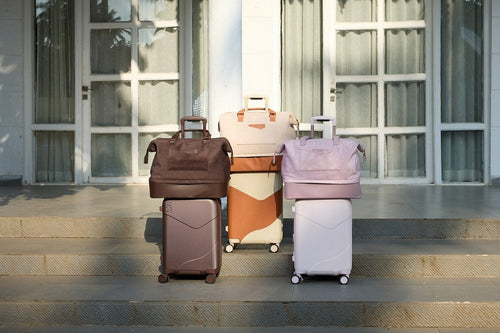
Mokobara skews unisex but leans male in colourway and silhouette: saturated-muted block colours, clean corners, gloss on most premium SKUs. Photographs like a lifestyle brand. That's the point.
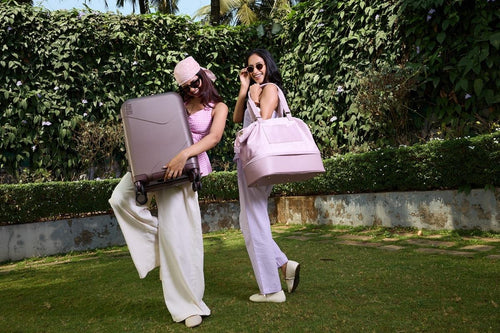
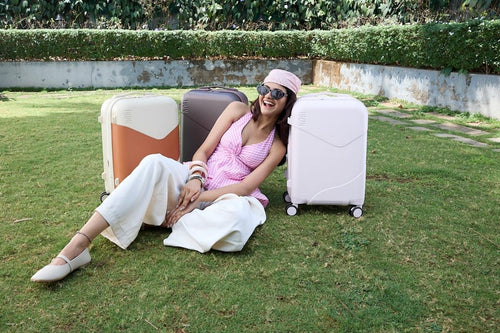
Assembly is more utilitarian. Palettes run to workable neutrals and sea-range blues; finishes tend matte — less "look at me," more "look fine after six trips." Iris is the one explicit women-led colourway. Shelf presence: Mokobara wins. Day-two-of-travel look: Assembly more forgiving.
Country of origin and manufacturing
Mokobara's Cabin Luggage PDP lists Country of Origin "PRC." Design, brand, company are Indian (Mokobara Lifestyle Pvt. Ltd., Bengaluru); manufacturing is abroad. Some SKUs read "PRC & Thailand"; the cabin flagship is PRC.
Assembly's PDPs state "India," treated as a positioning pillar. Around 90% of output runs through the founder's family facility. For buyers where made-in-India is a deciding factor, Assembly is the only one of the two that checks the box — and our wider best Indian luggage brand 2026 guide covers how the category's homegrown players compare.
Who should buy which
Choose Mokobara if the suitcase should also be a brand signal. You're buying a category-leading design language, recognisable silhouette, named German material, Japanese wheels, and a long warranty. You accept that the polished finish picks up travel marks quickly, and you're paying the premium that comes with category-defining visibility.
Choose Assembly if you want the spec sheet at the lowest honest price, care about made-in-India origin, and read a matte finish as a feature. You're buying a cabin that does the job for roughly half the Mokobara price. You accept a warranty story less clearly communicated on the brand's own site, and a return policy whose "no-questions-asked" headline rarely applies because the brand is almost always on promo.
First cabin for a value-focused traveller: Assembly. First cabin where travel is a statement: Mokobara.
FAQ
Is Mokobara made in India?
No. Mokobara is an Indian brand (Bengaluru), but the Cabin Luggage PDP lists Country of Origin as PRC. Assembly's PDPs state Country of Origin "India."
Is Assembly's warranty really 5 years or 3 years?
The warranty page states 3 years international on hard luggage. One live PDP (Stark Medium, Blue) still shows "5 years." Until Assembly reconciles, the warranty page is the safer reference.
Which brand has better wheels?
Mokobara names the supplier (Japanese Hinomoto) on the cabin PDP. Assembly lists 360° spinners with no named supplier. Both roll smoothly; the named-component story is the real difference, and matters if you value traceability.
Is Mokobara cabin luggage really worth double?
On pure materials and hardware, the gap is smaller than the price gap. What you pay for at Mokobara is brand-tier, design coherence, and a long-end warranty. Whether those are worth roughly double an Assembly cabin is a buyer-specific call.
Which brand has the better return policy?
Mokobara's 30-day trial is cleaner — it applies to full-price items including the brand's own constant promos. Assembly's "no-questions-asked" return applies only to full-price items; sale and promo purchases drop to defect-only exchange.
Do both brands fit IndiGo's cabin size?
Both design cabins around standard domestic guidelines, roughly 55 cm on the long edge. Every manufacturer runs minor 1-2 cm variation. Mokobara also has the Moko 6E IndiGo partnership trolley. At Indian gates, weight enforcement matters more than cm-level size — if shaving kilos is your priority, see our guide to the best lightweight cabin luggage in India 2026.
Where are these brands sold?
Both are primarily online-first through their own websites, with select offline touchpoints. Neither operates a national retail footprint at legacy-luggage scale.
Image Sources: Google Images, official brand websites, and publicly available media assets used for editorial comparison purposes only.